SpeakersBuilt to order
otoka h1. Made to be seen. Shaped by sound.
SpeakersBuilt to order
Every line of the h1 follows from how sound behaves in a room. The shape comes last.
A speaker in front of a wall meets its own reflection late and out of step, and loses bass where the two cancel. In the corner, the walls and the ceiling sit right behind the driver: the reflections arrive in step and add up.
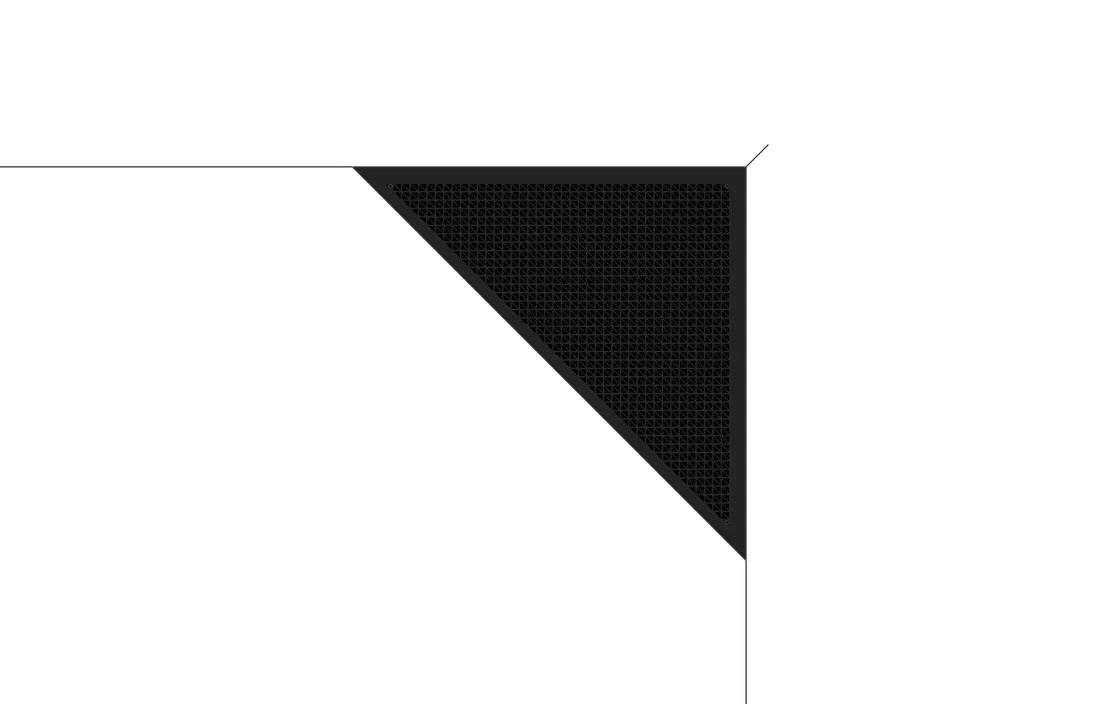
Inside the cabinet, sound has no two faces to bounce between, so no standing wave builds up in it. Outside, its rear faces sit flush against the two walls and the ceiling, and nothing stands between the driver and the corner.
A coaxial driver plays the highs from the centre of the mids. Both arrive from one point and stay in step through the crossover, wherever you sit, not only at one seat.
No port: nothing chuffs, the bass rolls off gently and stops when the music stops.
A corner drives the room’s bass modes hardest. With the Home set, the h1a’s DSP measures them in your room and takes them out, and lines up pyramids and subwoofer in time and phase.
Stiff and well damped, so the cabinet adds no sound of its own.
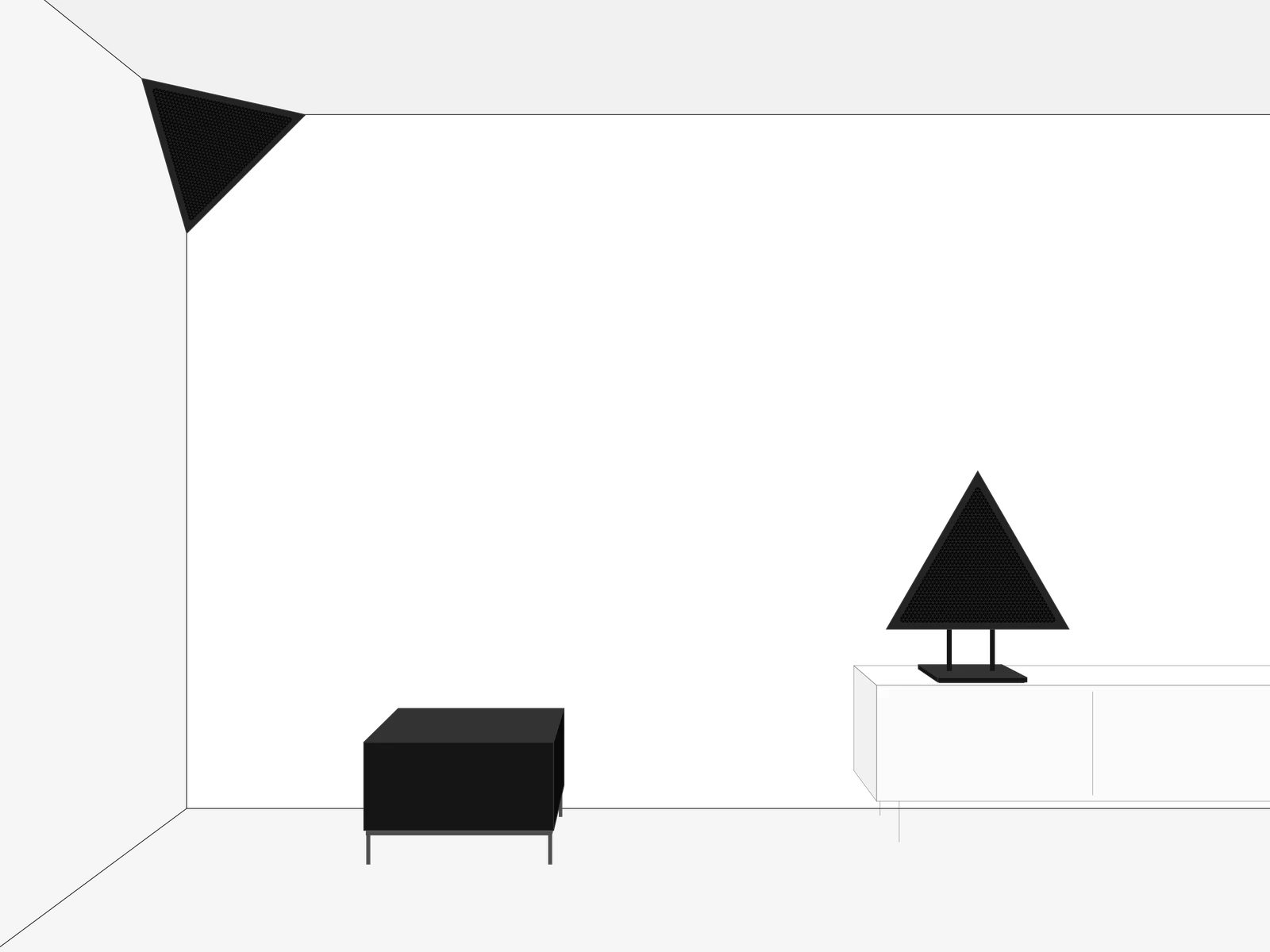
The h1c sits in an upper corner, point down, and nothing stands out below. Where a corner is not free, the h1s stands on two thin rods, point up, tall for the floor or low for a table or a shelf.
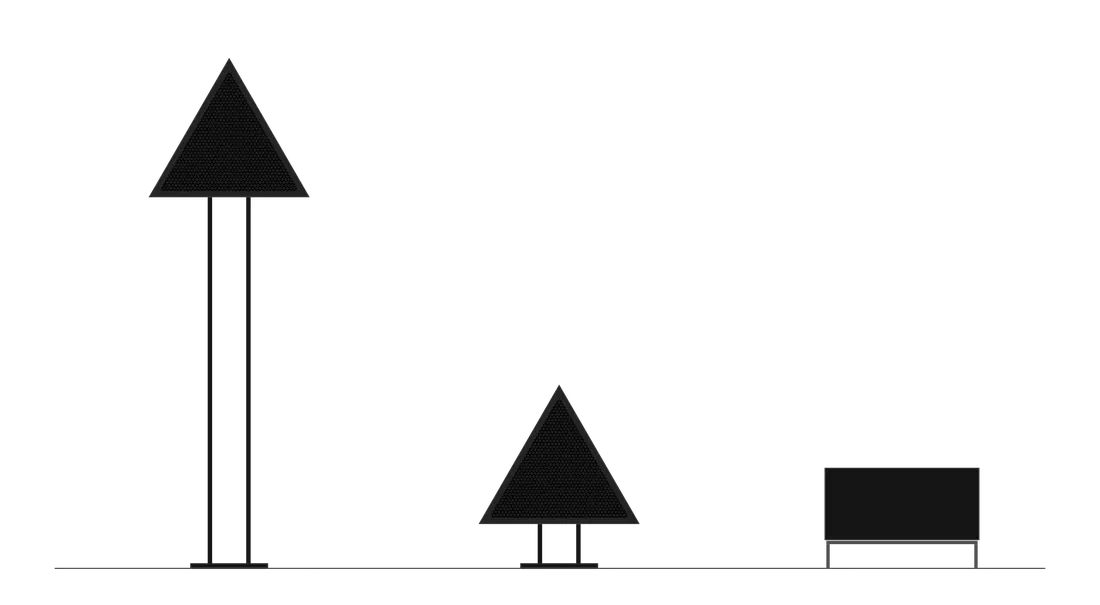
Black aluminium with a fine lattice of triangles. From the front, only the cover shows.

An addition to the Home set, for the lowest octaves.
Square and flat, it floats a hand above the floor on a thin steel frame.
No grille shows, and the bass leaves evenly on all four sides.
A port reaches lower on paper, but below its tuning the bass drops twice as fast and rings on after the note, and a port wide enough to stay silent would be about a metre long. Sealed, the bass rolls off gently from about 53 Hz, and the h1a lifts it cleanly down to about 25 Hz.
One set, estimated at the centre of a 6 × 5 m room.
| Corner pair | 2 pyramids h1c, each with its passive crossover; for any amplifier |
|---|---|
| Home set | 2 pyramids h1 and the amplifier h1a; the subwoofer h1w as an addition |
| Placement | h1c: in the upper room corner, on corner brackets; h1s: on a tall stand for the floor or a low one for a table or shelf |
| Pyramid h1 | SEAS Excel C16NX001, 5.25” coaxial; sealed, about 4.3 l; birch multiplex, aluminium front; passive crossover at about 2.5–3 kHz; edge 400 mm, about 8 kg |
| Subwoofer h1w | Purifi PTT10.0X04, 10”; sealed, about 55–60 l; down-firing |
| Range | the pyramids alone to about 90 Hz; the h1w on its own to about 53 Hz (−3 dB), with the h1a to about 25 Hz |
| Crossover to the subwoofer | about 100–120 Hz, aligned in time and phase (Home set) |
| Level | about 100 dB continuous, 105 dB peaks, at the centre of a 6 × 5 m room; with a second set in the other two corners about 103 and 107 dB |
| Amplifier h1a | every channel and the DSP in one box, with limiters for every driver; line and XLR inputs, headphone output on the front, Ethernet; streams on its own |
Every set is built to order. The corner pair connects to the amplifier you own; the Home set adds the h1a and, if you like, the h1w. Tell us about the room, its size, its corners and what you play in it. We answer in person with the price and the lead time.